
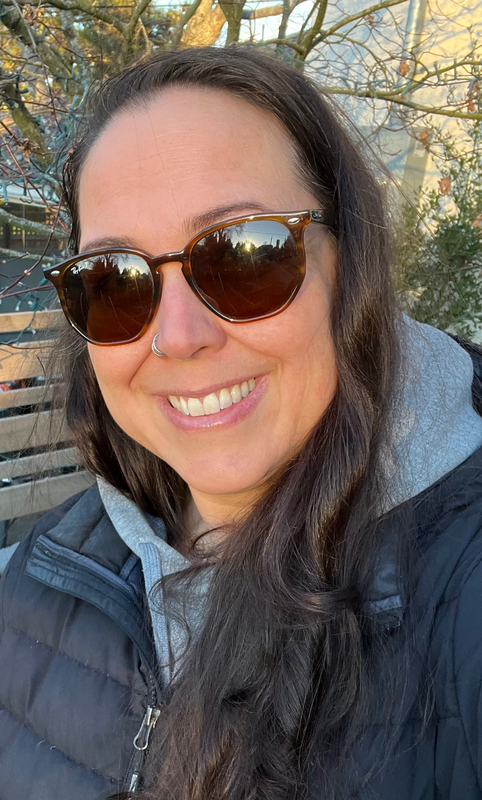
Rhiannon Webb, RTC ABS SSE
A note on academic philosophy & values:
I firmly believe in the importance of being a life-long learner for both my development as a person, and as a professional duty. It's also important to me to maintain diversity in the sources of my learning, understanding that traditional academia offers tremendous value but is also embedded in systems that oppress. So, it's important to me that alongside my formal education and ongoing professional development, I seek out non-traditional sources of learning that encompass diverse fields of healing, sources of knowing, and cultural roots. I feel this is the best way for me to work through a holistically ethical, human, and trauma-informed lens. Background After two decades of front line experience in the social sector, birth work, and teaching, I founded my private practice as a space in which to integrate traditional psychotherapy with the wisdom offered by other healing practices. My approach bridges developmental and emotion focused tools with somatic literacy to allow my clients to create deep, holistic, embodied relationships with self and others. A queer, cisgender woman whose identity spans artist, writer, educator, parent, and partner, I have studied, and subsequently taught, the art of embodied communication as a means to making connections. I have produced and delivered a series of workshops across Western Canada on embodiment and pleasure, and am regularly consulted as an expert or mentor by various educational organizations and media, such as Better Health Magazine, Teen Vogue, and We Rise Rooted: Social Action Labs. I am a regular guest writer for various blogs and publications on the subjects of relationship dynamics, parenting, and pleasure. Formally educated in counselling psychology, I have also completed collateral training in somatic sex education and sexological bodywork, and continue studies with Sexual Health Alliance, the Institute for Relational Intimacy, the Couples Institute, the Neurodiverse Partners Institute, the National Institute for the Clinical Application of Behavioral Medicine, The Gottman Institute, and the Institute for the Study of Somatic Sex Education. I am a member in good standing of the American Board of Sexologists, the American College of Sexologists, the Association of Counselling Therapy of Alberta (precursor to the College of Counselling Therapy of Alberta), the Canadian Professional Counsellors Association, the Association of Cooperative Counselling Therapists, and the Somatic Sex Educators Association. A unique contribution to my work comes from my post-secondary study of linguistic translation theory. Diving into the complexities of how human beings relate to meaning, phrasing, and emotion in the context of spoken language has given me exciting insight into the landscape of communication that takes place between people in any kind of relationship (the closer the relationship, the more complex the landscape). Therapeutic Perspectives and Approach A favourite quote of mine which I often share with my clients is: "I decided to see how my life would improve if I stopped assuming I needed to be fixed." I believe that people are wired to seek safety and belonging, and to ensure our needs are met. In seeking to heal ourselves or resolve life challenges, understanding how and why our needs aren't being met can create a functional path to experiencing life in closer alignment with what we want. My goal in this work is to support people to find the empowerment, bravery, and wisdom they naturally possess, and I believe that a strong, encouraging, and collaborative relationship is the key to getting there. My approach to healing work integrates the intellectual power of the mind with the profound wisdom of the body. I believe this creates an opportunity for meaningful healing and integration that is holistic and sustainable. I believe that early life experiences, our personal emotions, nervous system health, and personal identity intersections (gender, sexuality, race, neurotype, orientation, culture, age, etc) are the core influences of how we see the world. I firmly believe that having sociopolitical beliefs is part of, rather than a contradiction to, being a good therapist. The subjects of oppression and marginalisation, racial supremacy, and identity politics, cannot be extricated from healing work with others. These are the muckiest bits of our collective human experience and I believe they create harm for many if not all people. I have trained in and am therefore influenced by or incorporate the following: The Developmental Model of Couples Therapy: This model of therapy considers developmental and attachment theory to help both the members of a relationship and the relationship attachment itself to proceed through the healthy developmental stages of an adult relationship. It considers that we have necessary, successive developmental tasks that can get missed in childhood and/or in adulthood which can significantly impact the health and satisfaction of a partnership. Learning and integrating strengths and skills for these developmental tasks is the focus of this model. Emotionally Focused Therapy (EFT): EFT draws from research that supports attachment theory and believes that emotions are not just experiences people have, but that these are actually organizing principles of the human experience. In discovering the unmet needs that are being translated into our emotions, people can (re)discover the capacity for vulnerability, connection, self reflection, empathy, and compassion. The SSLD system by Ka Tat Tsang: This is a needs-based approach to growth work that looks at the intricacies of a person's intersectional identities through 'N3C' (Needs, Circumstances, Characteristics, and Capacity). SSLD focuses on bridging the knowledge-action gap so that people are supported to apply their insights to new patterns of behaviour or action. The Gottman Method: This method of couples therapy is based on decades of academic, scientific research. It includes a thorough assessment of the relationship and integrates research-based interventions based on the Sound Relationship House Theory. The focus is on disarming conflictful communication; increasing intimacy, affection, and respect; increasing empathy and understanding; and removing barriers that contribute to stagnancy. ND Compass: This method of couples therapy from the Neurodiverse Partners Institute is an approach that takes couples through 8 phases that will include: core processes of education; creating a day to day life that works for the relationship; and developing the relationship to a place of confidence, healthy autonomy, and healthy interconnection. Somatic Sex Education: Research in contemporary neuroscience explains that because of the subcortical nature of trauma imprints, we can heal and change only when we physically experience and practice efficacy, power and pleasure in the erotic realm. I do not offer hands-on bodywork in my practice, but with years of training and experience offering this work I have been able to bridge many of the tools, practices, and skills into this practice to create a unique contribution to the field of somatic sex therapy. Polyvagal Theory (PVT): Dr. Stephen Porges' PVT has enhanced and advanced our understanding of how our nervous systems engage and respond as social mammals, and how these responses can be engaged with in support of healing. Somatically oriented healing practices that support and strengthen the nervous system (including working with inflamed fight-flight-shut down responses) are often underpinned by PVT. Additional Relevant Study: Cultural Somatics Training in Racialized Trauma: This 5-part course addresses racialized trauma in black bodies, white bodies, policing bodies, and communal bodies. The process of understanding and working toward dismantling systemic racism is an ongoing and life-long subject of work. University of Alberta - Indigenous Canada Course: This course is taught from an Indigenous perspective and explores complex experiences Indigenous peoples face today from a historical and critical perspective highlighting national and local Indigenous-settler relations. Topics include the fur trade and other exchange relationships, land claims and environmental impacts, legal systems and rights, political conflicts and alliances, Indigenous political activism, and contemporary Indigenous life, art and its expressions. Personal I am a dual English-Canadian citizen with UK, German, and Scandinavian ancestry living uninvited since 2003 on the unceded Coast Salish territory of the Lekwungen and W̱SÁNEĆ nations, also known as Victoria BC. Beyond professional training and experience, I have lived experience as a member of the 2SLGBTQIA+ community, in blended family, solo parenting, pregnancy & birth, and as a neurodivergent person. My life-long passion for the arts continues to influence me and has led me to show paintings in local art exhibits, perform singing publicly, and create a cross-country flash mob for Pride in 2011 (here). I am a former director on the board of the Victoria Pride Society. I spend my down time enjoying quiet moments or close connections, basking in the ocean and wilderness of the West Coast, and building memories with my amazing partner and our family. |
|